
 Apple Podcasts
 Spotify
 YouTube
 RSS Feed
 100th Episode With The President And CEO Of Special Olympics International David Evangelista

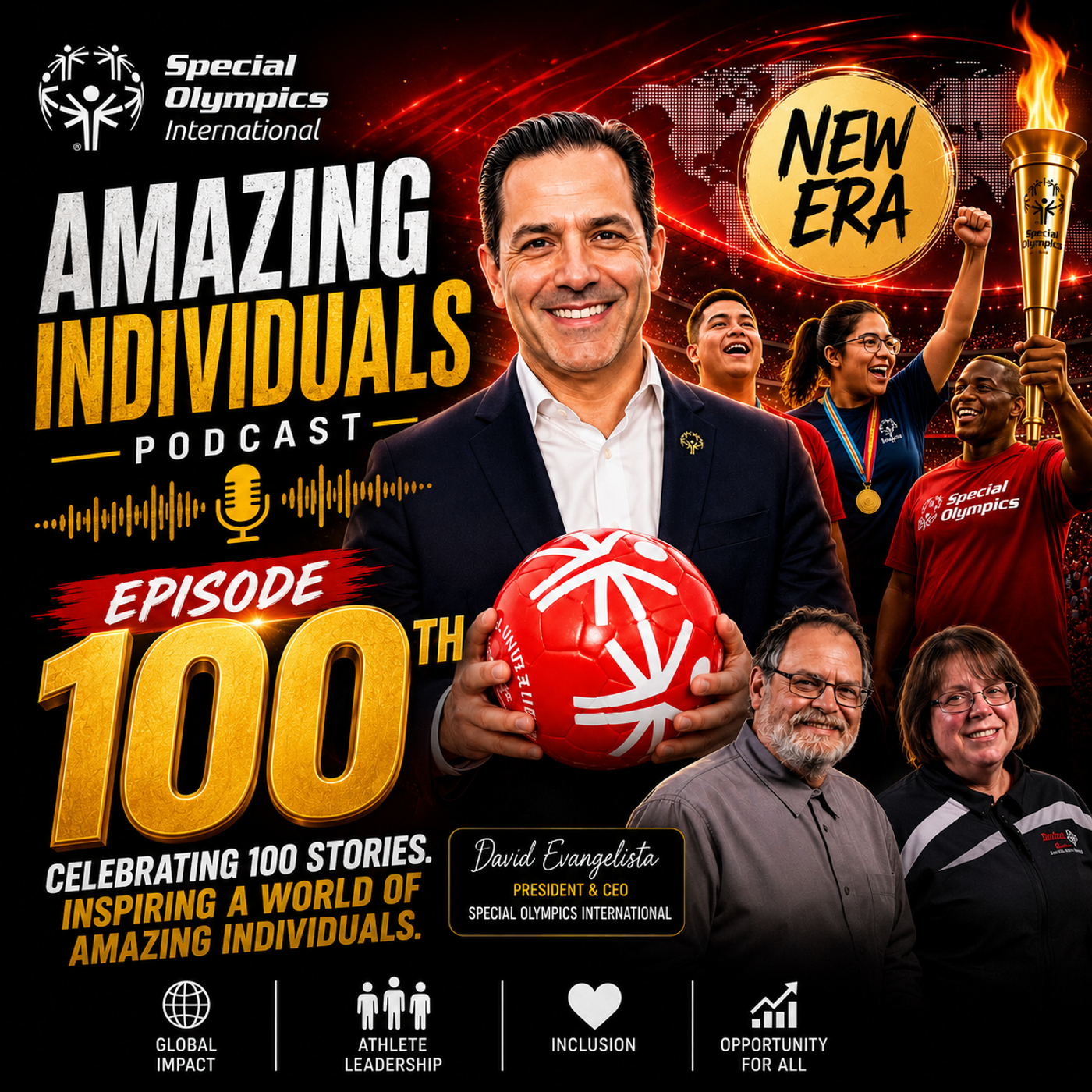
Celebrating our 100th episode with a conversation with the President and CEO of Special Olympics International, David Evangelista
speaker-0: So welcome to the 100th episode of Amazing Individuals. This milestone episode celebrates not only our journey, but also the inspiring stories of those who motivate us every day. We are your hosts, Lisa and Kurt Noebel, and we are thrilled to mark this special occasion with a very special guest, our new CEO of Special Olympics International, David Andriolista. Thank you for joining us for a heartfelt conversation about building a more inclusive world through sports and social impact. He shares his vision, leadership insights, and moving stories. Thank you for tuning in and celebrating with us with Lisa, Kurt, and us on the remarkable episode.
speaker-1: Thank you very much, Lisa. I'm thrilled to be here. And I want to thank you and Kurt for bringing this podcast and this platform to the forefront. want to also congratulate both of you. 100th episode, gosh, I'm honored. â What a number to represent. â In fact, if I can be so bold, can I come back for the 200th? Sure.
speaker-0: Yeah, absolutely.
speaker-1: That would be wonderful. you know, it's â I it's very fitting, Lisa, that you â rightfully titled this â podcast amazing individuals and having heard of you â and from you, it's clear that that title is very indicative of you and Kurt. â in dedication, amazing in your steadfast commitment. and amazing and you're willing to engage so many people and now a hundred of them. So well done and I'm ready to rock and roll.
speaker-0: Well, thank you, David. I appreciate that. that Congratulations on becoming president and CEO of Special Olympics International. Can you tell our listeners what inspired you to become, to get involved in Special Olympics and how you did, â how did feel when you officially stepped into the CEO role?
speaker-1: So well, thank you very much Kurt and Lisa I You know I grew up around the Special Olympics movement due to the involvement of my family in the organization around you know and it as part of the early years if you'd will when I graduated from university I'm just before the turn of the century. I I Was compelled to do something that mattered, you know like most young people â I was graduating university and I had to get a job and there was a â tendency to maybe go back to school and â stay in the academic sphere. I wanted to work, I wanted to get out and be independent and so on. And I wanted to do something that mattered. I wanted to do something that actually had meaning. â I didn't want to just take a job. And maybe, you know, I don't know if that was, you know, common or not. I just, wanted to do something that had meaning beyond just a, you know, a paycheck, if you will. I should also mention Kurt and Lisa that â I was heavily influenced by a professor of mine â from American University where I went to university. His name was Albert Mott. And he encouraged me to do my senior thesis, know, at the university, always did, everyone does a thesis on the study of eugenics, which is a field of study years ago that really was manipulated and created a lot of stigmatization and institutionalization of people with different abilities, not only people with intellectual disabilities, but namely. And so was very influenced by that work and I was heavily influenced by him. And so as I look back, I was intrigued by this idea that I could contribute to something not only that had meaning, but that as something that I kind of understood, I was involved in Special Olympics as a child and it made sense. â I could never have imagined the trajectory that I â experienced working at Special And so Kurt, to answer your question, was almost with, I want to choose my words wisely. â There was this mixture of incredible excitement, â honor, but also almost disbelief that I was appointed as chief executive officer simply because I have been with the movement for many years. I not only do I believe, but I've seen the transformational power that comes through our work. And so it was almost with disbelief that I said to Mike, mean, could this be real? Could it really be, you know, could I really be CEO? I mean, is it really, you know, you know, those things where you say to yourself, gosh, could this really be happening? â so, you know, it's with a great sense of seriousness and pride and responsibility. â that I take this role. â If I could be very honest in this podcast, there was also and still remains, I guess, a bit of trepidation and fear, â not fear in the traditional sense, given how serious this work is, given how urgent this theme is, and given the responsibility of representing and working with and empowering â amazing individuals like you and countless millions of others. â There's a great sense of â seriousness that comes from this. And that's something that I would say, Kurt, has been very clear to me. I've recognized â sometimes I have to take a deep breath and remember â how many implications there are to this work, to this movement. And I'm very proud to say that to both of you that
speaker-0: And.
speaker-1: that I always think, â you know, I'm not only leading a team, and in many ways I should say the team's actually leading me in some regards, â but I represent the, you know, together with our team, together with our chairman, Dr. Timothy Shriver, our board of directors, very esteemed board and what a prolific leader, and Tim Shriver, but... â that we're representing the dreams and aspirations of people and we have a responsibility to that. And it's urgent, it's not something that can wait. And so these are just some of the things that go through my head when I wake up in the morning and some of the things that go through my head when I'm going to sleep at night. â So Kurt and Lisa, I hope I answered your question.
speaker-0: You did and to follow up with that, â is your vision for the future of Special Olympics and how does it, I know we're trying to be more athlete led organization, â â is your vision of how â athlete leaders like ourselves can be part of that vision as well? â
speaker-1: â well, first off you you you are the part. I mean, you you're the you are you are the part. I I have a, I have a, â I have an eagerness to ensure that the athletes of Special Olympics â can manifest and amplify their voice in ways that we still have yet. to see in a more sustained way. For instance, Lisa and Kurt, know, it's very, it's not uncommon. I'm very proud to say this and we should all be very proud to say that, you know, it's not uncommon for media groups to come to our games, world games, national games, regional games. Even local newspapers will come to read, you know, local bowling tournaments or badminton tournaments or downhill skiing events. How many times are the athletes of special looks invited to the studio?
speaker-0: Mm-hmm. Mm-hmm.
speaker-1: How often are they brought to the table of government leaders? I think it's wonderful that government leaders will come to our games and meet our athletes and meet the families. How many times are the athletes brought to the tables of the government on decisions regarding people with intellectual disabilities, on the way in which government can be investing more in sports and inclusion and health and education? How many times has an athlete of special Olympics been brought to a major conference? that's not a Special Olympics event, that the voice of these athletes can amplify the message that these organizations or companies wish to disseminate. My vision is that â not only will we have media coming to us, but that we will go to them. â And I shouldn't say it's not just media, but let's face it. â Media holds a very important role in ensuring that the larger population around the world
speaker-0: Mm-hmm.
speaker-1: not only sees us but understands the urgency of our our creed. Let me win but if I cannot win let me be brave in the attempt let me demonstrate courage let me show you that I'm not so concerned about being a winner as much as I'm about about about being brave and about representing the ideals and principles of a movement that that can transform all of us. â That's very important to me. So that's the vision I have. â That we need to be more engaged and the athletes need to be at the table not only at our events, but in the bloodstream of the mainstream, as they say.
speaker-0: Actually that leads into your next question with the media too. Lisa and I are both athlete leaders in Podcast host. Why do you believe athlete voices are so important in media and storytelling?
speaker-1: I can't overstate, Kurt, how important I believe the storytelling ability of athletes are. â I'm very proud to say that one of the first kind of inspirations that I had as a very young adult â is Kester Edwards, an athlete from Special Olympics Trinidad and Tobago, who's now a sports official here in our headquarter office. a dear friend of many years. â His storytelling ability was what got me to understand, â you know, let me backtrack here. Many people told me, you know, what Special Olympics was. And many people in Special Olympics told me how Special Olympics was. And when I started working, I understood where. Special Olympics was and when you go to the games and you understand when Special Olympics is Kester Edwards taught me why Special Olympics is and â
speaker-0: Thank you.
speaker-1: the ability for athletes and the families and the volunteers and the law enforcement officers and the doctors and the teachers, but namely the athletes and coaches. Their story is what will teach people why Special Olympics. And at the end of the day, when we make decisions in our lives, You know what food we buy at the supermarket and where we go on vacation and what friends we go see on a Friday night or or What prayers we say before we go to bed or what breakfast we have in the morning We don't often think about this, but we we subconsciously we're asking ourselves why Why and so for me when when people are asking themselves Why is the world so divided? Why are we so against one another? Why can't we see each other? Why do we always chip away at people's dignity? Why are we dehumanizing? I also want them to ask themselves, â why is Special Olympics such a powerful part of our community? And why are the athletes so convincing? And why are the coaches so dedicated? And why are the families so engaging? I really do believe that the athletes ability to tell their story. and the families and the coaches is what will make the difference between our movement growing â and not. â Now granted, Kurt, there's probably a lot more to that than I could say on this podcast. there's a lot of times when you see, especially on the news and so on, they do this pretty often. â You can get lost in all of the statistics.
speaker-0: â
speaker-1: You know, you can get lost in numbers and stats and so on. you know, at the end of the day, â what most people are after, Kurt, is, you know, is Lisa and Kurt. Somebody with a name, with a smile, with an identity, you know, with a basketball sweatshirt on. â know, with, you know, people who actually, they can call and say, hi, my name's David, are you Lisa? Not, are you one of five million people? No, are you Lisa? Most people are compelled by... the individual, the humanity that connects us. I think in some regards we've lost that and I think the world is becoming increasingly agitated and irritated that no matter where they look, they're not finding teachers that are giving them lessons that actually matter. â know, whether it be politics or business or whatever it is, I just think the world is hungry for the amazing individual story. think that story is what's going to get people to understand, there's something better here. â forgive me, forgive the passion on this, but I really do believe that, Kurt, I think the athletes of Special Olympics, and it's amazing this happened 58 years after its founding, but I think that the athletes of Special Olympics are probably more important now than they've ever been in the history of our organization.
speaker-0: Yeah, and funny you should do it because I know that when we go to different events, know, trust you when they find out he's done it for so long, you know, then there's that what they always ask you, you know, how it was back when he started and what the difference is. they want to hear his perspective. And then that's we've gotten a few volunteers, you know, being part of the movement because of that, you know, because they've heard how long he's done it. You know how it impacts his life as well as, you know, when they ask, you know, both of us as well. So, I like, like you said, I think that, you know, just hearing our stories kind of amplify that. So, and I guess going into that, also hearing our stories though, how do you think you would mention, you know, having the athletes part of the decision-making process? how do you think that athlete leaders can play? a part in helping shape the future of our movement and why do you think it's important for the athletes to be included in that? â Sort of like the USALC or Athletic Leadership Councils or whatever.
speaker-2: Yeah, well, I guess.
speaker-1: So I think it's of the highest importance, and I'll tell you why. And I've got a couple of examples, if it's okay, that I'll share. Sure. â I think it's very important for athletes to be part of all of our internal organizations, the United States Leadership Council and the Law Enforcement Torture on Council and the Global Athlete Congress led by Kira Byland remarkably and Nyasha before and Gilmore Borg and Margaret Turley and so many other great athlete leaders. â I think it's also important that they be part of the the external. â For instance, and I'm just going to give a couple of quick examples, â there are many national governments around the world in countries like Romania and Jamaica and Kenya and Malawi and Vietnam and a number of countries that they have governments sitting down and they're developing policies and they're putting â budget allocations, they're pledging money. to a whole bunch of new strategies and new initiatives around inclusion and education and health and sport and so on. The athletes of Special Olympics have to be at that table. They have to be able to share with these decision makers why Special Olympics is the most cost-effective, cost-efficient, transformative sports model that brings improved health, improved education, all of these things. That, the input...
speaker-0: Mm-hmm.
speaker-1: of the athletes, their lived experience and their aspirations, but also their knowledge is of the highest importance to these governments. And by the way, Lisa and Kurt, we're seeing this. This is not what David thinks. This is what David has seen. But it's not happening enough. So, you know, do I have some examples? Sure. But I should have countless examples. I shouldn't have some examples. I should have
speaker-0: Mm-hmm.
speaker-1: an encyclopedia of examples. â So we have a lot of work to do. have a lot of work to do. The good news is we're on the right track. I just believe that we are right to be a bit impatient. 58 years has shown the world we are growing and growing and growing and our athletes get stronger and stronger and stronger. Our brand gets more and more visible. You gotta get us to the table. And it's these types of podcasts and leaders like yourselves that will be the of the glue that not only makes it happen, but makes it stick. Which is why I think it's remarkable. 100th episode, gosh, it's great, It's great.
speaker-0: Mm-hmm Mm-hmm. And David, that's kind of what I always say, like even on my, and that's what we actually in our last USALC meeting were talking about this, about how, you know, it's nice that you guys, you know, that there's a CEO and there's, you know, the boards, but ultimately the decisions that you guys make affect us in the long run. you know, we should, like you said, we feel like we should have, you know, and that's my passion is that we should have a voice at that table because Like I said, ultimately decisions affect offices, you know, in the long run. And, you know, it's great that you guys think of the, these ideas, but again, you know, to hear the athlete's voice about, okay, what is this policy? How, how do you think it's going to affect everybody? You know, an athlete or the athletes. So, you know, I think that would, you know, I think that's, it gets lost sometimes. So.
speaker-1: I do believe it gets lost and that's why we need to be very... â We've got to be very purposeful about it and we have to be almost kind of incessant. Lisa, I think we'll get there, but it's not going to be easy. Then again, it probably shouldn't be easy because if it was easy, probably wouldn't be worth much, if you know what I mean. â But the athlete leadership for me, Lisa and Kurt, is one of my three top priorities as CEO.
speaker-0: Mm-hmm. Right. Mm-hmm. Mm-hmm. â
speaker-1: I want to be investing a lot more in athlete leadership and I want to get more innovative. â I want to â invest more in our MATP programming that supports the individuals, our athletes that have severe and profound intellectual and often physical disabilities, their families. I want to support a lot of the work we're doing with national governments because I think Far too often national governments think that groups like us will just keep going because of people's donations. Lisa and Kurt are citizens of countries. And there's a Lisa and a Kurt in Cote d'Ivoire, there's a Lisa and Kurt in Paraguay, there's a Lisa and Kurt in Brazil, there's a Lisa and Kurt in Barbados. And those governments have an obligation to those athletes just like anyone else.
speaker-0: Hmm.
speaker-1: I don't believe it's the role of the private sector or philanthropy alone. think national governments need to understand that to host the strongest and maximized benefits of Special Olympics, it will come with investment. â And what better person to invest in than Lisa Noble or Loretta Claiborne or Lucy Meyer or Gilmore Borg? â Who better to invest in than an athlete who can show you
speaker-0: Mm-hmm.
speaker-1: â you know, â look. I now represent my neighborhood. I represent my nation. I have a job. I learned all of these things through the power of sport. I got an education. I have a high school degree. I have a university degree. I coach. I'm a community member. I'm a member. I'm part of my community. I'm not on the margins. I'm in the center. â I think national governments have an obligation and our job is to ensure that we â position Kurt and Lisa and athlete leaders like yourselves to tell that story. â Kurt, and that's why I keep going back to storytelling because a lot of these governments, they see all the numbers, they see all the budgets, they see all that stuff, but do they have a story that really gets under their skin? Do they have a story that says to them, gosh, I... I had never, I didn't even know this guy Kurt. Holy smokes, I can't stop thinking about what he said. You know, that's, that's my vision.
speaker-0: If I could tell you my life story, would go on and on. And it wouldn't stop. Because it's so long. Yeah. â I mean, like you said, people don't realize like, you know, like he, what is it that â you started competing, but like now you're giving to. Yes, I'm volunteering. I'm â a team manager now for our team sports for the sports you don't play anymore. For the sports I don't play anymore. So I'm team manager now and I really enjoy it. So, but again, that goes to the storytelling, like you were saying, is like, you know, it shows like the community that, you know, he's just not an athlete or he's just not somebody with an intellectual disability, that he can actually be part of something and be part of the community. So.
speaker-1: That's exactly right. I think the more... The more we tell the story that he is a fully fledged member of the community, it will actually make the Special Olympics engagement even more powerful. Because everyone will look at, know, wow, you know, he does all this stuff for his community. Well, what's the connection to all those things? Special Olympics.
speaker-0: Mm-hmm.
speaker-1: You know, how did he get a job? He got a job because he learned all these skills, you know, when he was competing and training at Special Olympics. How did he learn how to publicly speak so well? Because he underwent the athlete leadership training at Special Olympics. You know, how does he know all these people? Well, because he's been an engaged athlete, you know, coaching and training and meeting people all these years. Gosh, how does he know so much about the community? Well, because he's lived in it.
speaker-0: Okay.
speaker-1: And because Special Olympics gave him the opportunity to come out and play badminton and play basketball, but also meet the school leaders and meet the local doctors and meet the local mayor and all these things, people will end up saying, gosh, this just so much, know, this guy, Kurt, he's really someone, he really knows his stuff. And how do they get to know all this stuff? And everyone will intuitively say, must be Special Olympics.
speaker-0: Mm-hmm. Mm-hmm.
speaker-1: And I think, Kurt, you would agree with me that it probably is Special Olympics. So that's what I think.
speaker-0: Hmm. Yeah, no, but I, yeah, you agree, right? That, you know, I, especially when it was kind of gave you, you know, changed the direction of how your life was. So, yeah. And actually, David, funny story is that he's the one that got me involved in in the first place. So I was covering, we probably from major neck surgery and trying to figure out what else, what I could do. And he had me come and meet his, his coach and then, you know, the rest is history. So. So I think, like you said, if I can do it, you can do it. Yep. Exactly. here we're just here.
speaker-1: Yep.
speaker-0: What are some of the biggest challenges facing people with intellectual disabilities globally today?
speaker-1: I think that people with intellectual disabilities still face... â and it really gets under my skin. They still face that terrible. almost torturous â stigma of misunderstanding and just so much stigma, so much stigma. If people knew the excitement, the value, the love, the unity, the richness that comes from engaging the athletes of Special Olympics and people with intellectual disabilities, if they knew, like so many know, like Jenny Fortner, your friend in mind, Jenny Fortner, who knows so deeply what comes from engaging in this movement, â the world could look so different.
speaker-0: Mm-hmm.
speaker-1: And families could be celebrated and siblings could be given a whole new understanding. Countless companies could be better and countless nations could be healthier. And instead we just operate from this completely lazy standpoint of you're different so you must be less. And it's... It's so backward â in so many regards. I understand in some regard, maybe it's natural and that's our job and that's our mission and I take it. I take it willingly. But I think one of the biggest challenges facing people with intellectual disabilities is the rest of us that we're still showing signs of of not wanting to do the work and just getting lazy. And you see it, you see it in politics, you see it in some, you know, some, a lot of the media stuff, you know, the biggest challenge I believe is that people with intellectual disabilities still have national governments and national populations that have not awoken to the transformational power that comes from from our work. Now, it's easy, Kurt and Lisa, for us to simply blame the rest of them. But it is our obligation to invite. You there's a reason that I'm here. I was invited.
speaker-0: Mm-hmm.
speaker-1: And we have to invite more and people to the national games and state games and local games. That's our party. That's our party. â So, you know, that's the biggest challenge. Now, there's a lot of subsets under that, I don't want to give you the impression, the biggest challenge is that the population hasn't woken up to the power of our movement. There's a lot under that. And the biggest challenge, I believe, is that, â yeah, people still find it appropriate to stigmatize.
speaker-0: Mm-hmm.
speaker-1: and It's so damaging to everybody, everybody. No, really, it's damaging to everybody. I guess what really bothers me, Kurt, is also it's so not true. â It's such a falsity that it's one of the areas that just gets me so, I don't want to say angry, motivated to continue to try to make the difference.
speaker-0: Mm.
speaker-1: You know, that's I'm not angry about it. I'm maybe I'm irritated, but but I I it does motivate me. I mean, when I see the news and I see certain things that. You know, I don't I don't I don't sit there with smoke coming out of my ears, I sit there with fire in my belly to keep going. Because let's face it, let's face it, anger. What? That's not a good emotion. Right. That's and that's not a transferable emotion.
speaker-0: Mm-hmm. Great.
speaker-1: I don't want to make other people angry, but I could help motivate other people.
speaker-0: Yeah, and like you said, it's, â you know, that's one of the reasons why, you know, we started this podcast in the first place was because, know, you, there is a lot of stigmatization, you know, people kind of put everybody in categories and you know, this, we wanted to highlight that everybody's unique in their own way, you know, and, know, just because you might have autism or because you have like a, â traumatic brain injury or something doesn't mean you can't. accomplish whatever you want. You know, might need a couple, you might need a little help along the way, but it's not like you can't, you know, be a productive member of your society. So.
speaker-1: Well, I
speaker-2: think that
speaker-1: I think it requires populations to understand â what productivity means. â
speaker-0: Mm-hmm.
speaker-1: You know, when we put together a young athletes event and we have all these small children with and without intellectual disabilities playing together, tumbling together, you know, falling over together, â laughing together, throwing together, you have families coming together and learning about their experience with their children, their experience in schools and their experience with the local doctor and this new law or this new policy or this new...
speaker-0: Mm-hmm.
speaker-1: initiative or the new school bus, whatever it is, that's highly productive. There's information, there's connection, there's sharing, there's a sense of solidarity and unity. But if you look at it strictly from a business profit standpoint, you'd say, where's the benefit there? Well, I'll tell you what a benefit is for me. You know, so there's many children playing in that young athlete event. And let's say that there's 50 children. And let's say of the 50 children, 10 of them do not have an intellectual disability. And let's say one of those children, his name is Roger. And let's say that Roger is six years old and he's playing with a bunch of two-year-olds and he doesn't see difference. He just sees kids playing.
speaker-0: Mm-hmm.
speaker-1: And so, you know, he's six years old and he's throwing, you know, throwing and tumbling and jumping and all of these things. And his mother is taking great pride. They look at Roger and, you know, it's wonderful to be here. And we have all these families and it's great. And some of them I go to church with and I even work with one of them. We didn't know that, but in all these things. then Roger, Roger grows up and then Roger becomes 36 years old. And all of a sudden Roger is running for public office and maybe he's going to run for mayor of his town. and he's 36. One of Roger's first memories in life was playing. He didn't see difference. Now at 36 years old, he might, because the world can be cruel like that, but he will always remember there's actually not a difference. I didn't see the difference. was told to see a difference, but I didn't see it. I remember when I was there with my mom and dad and I was playing with all these kids and I didn't... You now have a mayor at 36 years old who really understands the power of inclusion, who really understands the power of unity, but really understands the value here, not just the excitement and how nice it is, but the value. That's highly productive. Now, it does require a deeper sense of understanding that you have to exchange immediate satisfaction
speaker-0: Thank
speaker-1: for long-term gain. So if people are looking at this from a productivity standpoint, there will need to be a different set of evaluation tools, if that makes sense. â I often think about...
speaker-0: Hmm?
speaker-1: people who have experiences around our movement at a very young age and how many of them are still involved somehow some way. And you hear this Lisa and Kurt over and over again, which shows me that it's kind of up to us to get that multiplier effect. The more people we get involved, the more people stay involved. And they always talk about, â I went to this polar plunge, or I remember volunteering at this basketball event, or my mom was a special education teacher, or my sister was a special Olympic athlete, and I've been part of it for 40 years, and I say to myself, gosh, what if there were hundreds of thousands more of those people? What would the world look like? So â I believe that Mrs. Shriver's brilliance was making Special Olympics completely grassroots.
speaker-0: All right.
speaker-1: Now we have a world games, but it's a grassroots thing. â And I think that's how we can get more and more people. just think that the group platforms like this, amazing individual is really important, really important. I mean, this is a good example of what I'm looking for from athlete leadership. This is not a special Olympics platform. This is a Lisa and Kurt platform. I happen to have the honor of joining you, but tomorrow you could be working with a refugee. next week you could be interviewing the local mayor, maybe his name is Roger. The point I'm saying is this is what I mean. You're taking your voice and you're saying, I have something to say. I'm a productive member of my community. I have opinions. I have lived experience that could be valuable to people. I enjoy sharing my story, I'm gonna bring it to the world. That's our creed. Let me win, even in amazing individuals. But if I cannot, let me be brave. Let me try, let me, let me, because let me tell you something, and Lisa. Many, many, many, people, they talk about doing things. Very few of them actually go do it. And it's easy to talk about who's playing in the arena. It's really difficult when you're in the arena.
speaker-0: Mm-hmm.
speaker-1: and you're in the arena. know, and Lisa aren't just talking about a podcast. You've done this a hundred times.
speaker-0: Mm-hmm.
speaker-1: for me, this is the greatest manifestation of what I hope to see with athlete leadership in our movement because it's you can make it Special Olympics, but you could also bring it. You can bring Special Olympics to new sectors, new audiences, new people, new ideas. â Currently, I'm not going to do that. Well, you're going to do that.
speaker-0: And if it's kind of like what we were trying to do when we went to we did our show in Florida at the USA Games and then that's what we're trying to try to do when we bring it to Minnesota so the next USA Games so, you know, we kind of you know, you know, it's not just when I'm just interviewing like As the athletes are competing but we're also the coaches and â family members and you know, whoever that we can, know, who's ever there to kind of say, you know, it's not just about, and it's just not about the, this week of competition. It's, this is a whole big movement and you know, yeah. And it's not just about, it's about the coaches and families and the support system. So yeah, that's what we try to do. So.
speaker-1: It's, you and you said something really interesting there, Lisa and Kurt, support systems.
speaker-0: Mm-hmm.
speaker-1: Don't we all need them?
speaker-0: Hmm?
speaker-1: Everyone always talks about how, you know, people with intellectual disabilities, you know, they need support systems. I don't know of anyone who doesn't need a support system. I don't know of anyone who doesn't have a special need. Everyone I meet, I don't claim to know, you know, a lot of people, but I know people. All of them need support systems. All of them have special needs. All of them have insecurities. All of them want to be seen. All of them want to be brave. How many of them have the bravery to be brave? I mean, how many can be Lisa and Kurt? I think that both of you are unique. you know, it's again, many people talk about doing things. You're doing it. â But I believe that there's a common â common denominator here. There's a there's a there's an adhesive.
speaker-0: Mm-hmm.
speaker-1: that connects us together at a level that anyone can see. Even your six-year-old Roger, who's playing with his friends. He doesn't see autism. He doesn't see Down syndrome. He sees John. He sees Carla. He sees Paul. He sees Rodrigo. He doesn't see difference. He sees peer. He sees play. â I think support systems are so important, but I don't believe they're exclusive to any group. In many ways, currently, so you're my support system. I'm a new CEO, I'm nervous. I'm trying my very best. When I'm invited to this, I gain confidence that somebody wants to hear my opinions. Somebody wants to hear my vision. I can ask questions, you can ask questions, but I was invited. Somebody invited me. Somebody was showing me that we value you. It's a huge confidence booster, Lisa and Kurt. And that's what we can be giving to larger parts of the public. Come to our games. Experience our... Look at the way the world could be. Meet Lisa. Meet Kurt. Meet Roger. â Be a coach. Just cheer on. Enjoy yourself. Grab a hot dog and...
speaker-0: Hmm?
speaker-1: and watch the 100 meter and, you know, and that's the beauty of Special Olympics. It's just a big invitation. Well, what do I do there? Whatever you want. If you want to coach, coach. You want to volunteer, volunteer. You want to be a spectator, be a spectator. You want to hand out water bottles, hand out water bottles. You want to meet the athletes? Ask. I think it's a beautiful thing. Listen, in a world that is so scripted,
speaker-0: Bye!
speaker-2: Everything's so s-
speaker-1: scripted. Special Olympics still gives you that freedom of spirit. And I just think it's incredibly addictive.
speaker-0: Mm-hmm. What would I think about?
speaker-1: the passion I love forgive the passion but I love this
speaker-0: What I look back at Special Olympics is what the old means. know, because when you read the old, I take it seriously. you're never, whatever place you come in, whether it's first, second or last or somewhere in the middle, â you're never a loser. And, you know, it's like, so if you lost, just, you try again and you keep building that up. And that's what I've done all these years. And I've been on TV, I've met lots and lots of people over the years. And so. That's one of the things that that's why I'm giving back. And I really, you know, I'm really enjoying them. And that's what you tell our team too, right? Yeah. Yeah. That as long as you have fun, you're right. And do our best. And just, just do your best. You know, you're going to make mistakes. You're going to make mistakes. And that's, that's part of it.
speaker-1: as
speaker-2: So.
speaker-0: â
speaker-1: I know we're closing soon. â Kurt, it was really important for me to hear those words. It was really important for me to hear from you. And not just in my role, just in life. Mistakes are part of it. Right. Now, I don't believe all mistakes are equal. Right, right. I don't believe all mistakes are equal, but I it's really powerful for me to hear from you as an amazing individual yourself and somebody who has been part of this movement since 1979. That that mistakes are going to happen, right? Except the mistakes do your best.
speaker-0: Mm-hmm.
speaker-1: But you gotta do your best.
speaker-0: Mm-hmm.
speaker-1: Whatever your best is, but it's gotta be something you can look in the mirror and say, was the best. I gave it my all. â I'm gonna think about those words, Kurt, for the rest of the day today. I want you to know. And I will. Mistake, you're gonna make mistakes. But it doesn't prohibit you from doing your best. Maybe, Kurt, maybe, Kurt, doing your best requires mistakes.
speaker-0: Bye. Mm-hmm. And it's going to happen, you know, you build up to that. That's why you practice, you know. So just like me being team manager, I got nervous when we started playing basketball because I had to learn â how things work and where to put stuff and what I needed to do.
speaker-1: BIT MADE Yeah, it's.
speaker-0: But now I've got it down on paper and I study it, just like in all the sports that I do now. And you still make a little bit of mistakes, but everybody does in life. That's all right.
speaker-1: so grateful that I was invited here. really needed this messaging. In many ways, Kurt, you answered your own question, your storytelling. You're telling the story, becoming a team manager, telling the story of how you overcame insecurity, that mistakes are something you accept, and you keep going, and mistakes are part of the journey. What a great way to end the call where you essentially gave me the exact model I'm looking for. Exactly. No, let me end where I started. It's the most fitting title for this podcast, Amazing Individuals. I'm speaking to two of them. â And I hope one day, and Lisa, I can be one. I really do. I hope one day I can be an amazing individual. â But I can tell you, â I'm looking at two of them. And â I hope that I'm going to share with my team to keep track of amazing individuals. When you hit 198, I'm going to call you, Lisa, and say, I get on? Can I be the 200th? I look forward to promoting this on my social media channels. But most importantly, Lisa and Kurt, if I could ask, â please keep in touch. Please give me a chance to keep. â I'd love to hear and be part of your journey and your story. I'd love to be able to tell your story or position you to tell it yourself, which is the far better option. And thank you for the invitation. It was very generous of you. I've so enjoyed this and I hope that other colleagues of mine can have the same invitation. But â I guess to use the very vernacular phrase, you've made my day. So thank you very much.
speaker-0: Well, thank you, David. Before we end, if you could share a message with about Special Olympics in the future, what would that be?
speaker-1: If you want to discover the best side of yourself, if you want to see the best part of your community, and if you want to create a world that manifests those good parts, you have to look no further than Special Olympics. It's a movement of inclusion. It's a movement of discovery. If you want to discover the best Lisa Noble, join Special Olympics. If you want to discover the best part of David Evangelist, to join Special Olympics. If you want to discover the best parts of your country, your neighborhood, join Special Olympics. Basically, Special Olympics makes you better. That's what I would say.
speaker-0: Well, thank you David so much for talking with us and helping us celebrate our 100th episode and we will definitely have you on when and with the two
speaker-1: I'm coming for you for 200. I want 200.
speaker-0: Not a problem, so yeah.
speaker-1: But listen, will continue to, â I'll continue to stay in touch. â You'll probably get a thank you note from me, because I believe very much in saying thank you. â But most of all, keep going, keep going, keep going.
speaker-0: Well, thank you. you so much David again for joining us. We really appreciate it. We â
speaker-1: Very welcome. Please let me know when this is going live so I can have my team put it out on social media. â
speaker-0: I definitely will,